Tuesday, 24 March 2020

Coronavirus - Keeping A Head


Was it only the beginning of March that some of us were laughing off this dreadful virus? Lots of jokes were doing the rounds via the internet and most people were carrying on as normal. What a difference a couple of weeks makes. Now it is no laughing matter. There is stockpiling, social distancing, escaping to the country or - unimaginable - being forced into lockdown for an unlimited time. 

Two weeks ago, I was at the cinema watching one film and thinking about seeing another. Days - but a totally different world later - The Times tempted me into an online article entitled “The Truth: Two icons are finally sharing a screen."

I was amazed at the article. “What?”, I thought when I saw it was about Catherine Deneuve and Juliette Binoche, the film I was so looking forward to at my recent cinema visit. “Who cares? How can they pretend this is important?” Life is definitely not going on in the way I’ve always known it.

Good advice
I have some important work to do - important in that it affects my future, not important in world terms - and I cannot be bothered. I am afflicted with this extraordinary malaise. I have very little concentration and I cannot manage more than the odd WhatsApp communication, which usually dampens my mood further.

What is a person to do?

When someone decides s/he would like to explore their inner world through psychotherapy, we, as therapists, will often try to help them get in touch with their hidden feelings, feelings that may have been hidden for many years. It may take time and hard work but when that process ends well - and it often does - it’s very satisfying for both client and therapist. Being in touch with your feelings can be the key to living a healthy and enjoyable life.


Therefore, what I’m going to say here goes completely against what I would usually say as a counsellor. But it has to be said. Here goes... 

NOW IS THE TIME TO LET THE HEAD RULE THE HEART. NOW IS THE TIME FOR RATIONAL BEHAVIOUR, NOT AN OVERREACTING EMOTIONAL RESPONSE.  

Let me explain. Life is frightening at the moment and, when we are frightened, we go into instinctive response mode to dealing with it.

Our reptilian response (led by the amygdala and the one that we needed in order to survive in our prehistoric days) goes into flight, fight or freeze mode. It’s also known as our primal brain and it serves a very useful purpose to protect us when we sense we’re in danger.

I have written about it before when talking about hyper-vigilance. It was appropriate then but we are no longer in “normal times”.

Learn different skills when working from home
In a literal sense, we are in danger. We are in fear of losing our lives or of those we love and that is the greatest fear we can ever have.

But, set against that, we’re not facing a moment-by-moment life-threatening situation where a hungry lion or tiger has appeared in front of us and, in this instance, we have to react at speed and therefore need that primal response. It makes us react fast and unthinkingly and is an instinctive and instant reaction to save us in a split second when we do not have time to think. However, it is not a response to hold on to for any length of time.

We in the West have been lucky in recent years. Unlike other parts of our same world, we have not been caught up in the relentless terror of war or social disruption and we have been given the chance to develop and move on to live in a society where most of us are not in imminent danger. That has allowed us to further develop and advance our way of thinking, allowing us to become the chillaxed, untroubled people we like to believe we are.

Clever as always
Not so now. Unfortunately, Coronavirus/Covid-19, has shown us how quick we are collectively to revert to our primitive selves. We are now in continuous panic mode and that does not help us to make sensible, important decisions. Stocking-piling loo paper, for heaven’s sake. Why? Just because someone else started it does not mean you are doing a clever thing. This is a virus that affects the lungs, not the posterior. Stockpiling loo paper is a bum decision.  

We are told we are at the beginning of this and we are presently in a position where we feel helpless, fearful, unable to trust - because those we vote for have no idea either - and, worst of all, there is nothing we can do about it. No wonder we are scared.

So, may I suggest we each individually learn to avoid the chaos swirling around our minds and instead concentrate on finding way to manage our own scattered thoughts. Personally, I am going to comply with official advice (this is not my time to rebel) while hoping the authorities are doing their best. 

I am working on the rational notion that none of them wants to be in this situation either and, while confined to my little home, I will allow myself to escape this world by reading, listening to music, watching escapist TV and maybe doing the odd stretching exercises. I will also talk to friends, rather than text them and appreciate the value of human contact, even if it is not in person. I will remember how I feel about that now and take it with me afterwards - and there will be an afterwards. 

I am going to be very aware of what is going on for me physically so I can connect my body to allow me and monitor my health. But, as far as my head is concerned, I am going to put on my “thinking” rather than “feeling” hat and use the rational part of my brain to guide me through the over-abundance of information that is out there.

Hopefully, with practice, my brain will settle down to do the job it has evolved to do and that will give my body a chance to calm down and stay strong. I wish you and your loved ones well.


Photo 1 by Nick Fewings on Unsplash
Photos 2 and 4 by John Cameron on Unsplash


Monday, 9 March 2020

A Borderline Problem


How would you feel if someone in a position to know told you that you were “emotionally unstable” or diagnosed you with a “borderline personality disorder (BPD)”?

The first diagnosis might bring on a feeling of indignation … “How dare you! Who are you to judge me so?” while the second - if you’ve heard of it - might be a sense of relief. “Phew, just borderline. That’s all right then.”

Whichever reaction you had, you might be surprised to know that both diagnoses mean one and the same thing.

Emotional instability is a diagnostic term used by European/British clinicians, referring to the World Health Organisation's health classification list, while the more medical-sounding term BPD is given by the DSM, a US manual used by psychiatrists around the world as the standard for mental health diagnoses. 

To understand what it is you would have to live with regardless of its name, I’m going to quote the DSM again.

“Borderline personality disorder: a pattern of instability in personal relationships, intense emotions, poor self-image and impulsivity. A person with borderline personality disorder may go to great lengths to avoid being abandoned, have repeated suicide attempts, display inappropriate intense anger or have ongoing feelings of emptiness.”

The impulsive behaviour category includes risk-taking such as casual sex, binge drink and drug abuse, a tendency to self-harm on a regular basis, all of which tends to bring on a chaotic pattern of behaviour. That, in turn, makes what is already a hard life, seem even harder to live. Sometimes, they cannot bear to continue.

Mood swings may be sudden and extreme
Soon after qualifying, I attended a course on BPD and thought I recognised a lot of the signs in me. I stuck my hand up (old habits die hard!) and said: “I’ve got it!” The psychiatrist laughed and said most people learning about the disorder thought they had at least some of it. It was unlikely.

After that, I began looking into the subject with interest and have subsequently discovered I still seem to be one of the few interested in it, rather than the many.

BPD is a difficult diagnosis. It seems to evoke some kind of dread in the medical world because there is no “cure”. Unlike other mental health issues, there is no evidence of any medication having a significant effect.

If, as a professional, a person feels despairing at the thought of being unable to find a way through a client’s discomfort, imagine how the client feels, being told nothing can be done. In a world where we’re told that everything can be achieved, being unable to “improve” something as fundamental as “oneself” is unimaginable.

To be fair to the medical/therapeutic community, working with people with BPD is not easy. Therapy works best when there is a good relationship between client and therapist and a BPD client can be challenging.

S/he - it affects more women than men - can be easily triggered, quick to imagine an unintended slight or to misinterpret what has been said to them. Their mood in a session can be highly changeable, making it is easy for the therapist to feel off-balance. This is not the BPD client’s fault.

Ideally, toddlers will learn to regulate their emotions
The disorder has developed out of a difficult or traumatic time in childhood, as a result of insecure (disordered) attachment and a BPD client may have retained those strong child-like tendencies of emotional extremes They love quickly with deep passion and can hate, discard and leave with that same passion. You can be their best friend or their worst enemy within a very short time. If it is wearing for the counsellor, imagine how tiring it must be for the client. What is charming in a child is unnerving in an adult.

Now, hopefully, change may be coming. For the first time ever, the Royal College of Psychiatrists has issued its own statement about BPD, saying: “The myth that people with personality disorder cannot be treated is damaging and untrue.” The college is calling for more training in the assessment and diagnosis of personality disorder. It also wants a better deal for sufferers, including access to mainstream services which are currently not available.

While there may not be an actual cure, people with BPD can learn skills to enable them to manage their life in what they might find to be a less tempestuous way.  There is dialectical behaviour therapy, developed by Marsha Linehan, herself a BDP sufferer and, more recently, mentalisation-based therapy, with both therapies aiming to help the client live in a healthier way mentally than they have managed to so far.

I was reminded of BPD last month when I read of the sad death of Caroline Flack. It was a tragic story. I later read a question on a public site, referring to her and, in the same post, asking about BDP. No-one can answer that. 

It’s popular at present to talk about avoiding diagnosis and concentrating only on the patient/client as an individual, not as a collection of symptoms. I understand the compassion behind that line of thought.

However, I wonder how it would be if a person displaying many of the symptoms of a potentially life-threatening disorder presented themselves to a professional and was alerted to what might be going on within their inner world.

It could be a life-saving moment.


Lulu Sinclair


Photo 1 by Jan Kopřiva on Unsplash
Photo 2 by Andre Hunter on Unsplash


Wednesday, 19 February 2020

The Hazards Of Identity Politics

I was going to write something non-contentious for this blog but then I read about Labour leadership contender Rebecca Long Bailey’s aim to “stamp out” transphobia.

Soon afterwards came the judge’s ruling on “hate speech” in which Mr Justice Julian Knowles warned Britain is heading towards an Orwellian society if it isn’t careful.

His warning came after a police officer told  a man who tweeted on the transgender issue that his tweets would be recorded as a “non-crime hate incident”.

What exactly is that - and who decides what a “non-crime hate incident” actually is? That really is a strange phrase and yet it is said with a straight face.

The phrase Identity Politics comes to mind.

According to one definition, identity politics is “a tendency for people of a particular religion, race, social background, etc., to form exclusive political alliances, moving away from traditional broad-based party politics”.

I thought the idea was new but I read it has been around since the 1960s. And yet it's only just caught on in a big way.

I suppose we were in the middle of a Cold War between East and West in the 1960s and united in our disdain for “the other” so perhaps it was not its time to shine.

Why has this happened now? Perhaps, since 1989 and the fall of the Berlin Wall - and the worldwide web of course -  we have had the chance to explore other political ideas. So, what was once a teeny pebble in a pond is now threatening to engulf empty the pond via a tidal wave. Excuse the mixed metaphor but I think that pretty much mirrors my astonishment at how a society that once seemed reasonably cohesive now appears so fragmented.

Identity makes it personal
In psychoanalytical terms, the belief is we all have a need for “the other” - the person or thing on which to project all the feelings inside us which we cannot bear to acknowledge within ourselves - so perhaps identity politics has arrived to take the place of “the other” within our lives.

 Identity is at the core of all of us. Look at small children and they’ll tell you their names, their ages, their gender ("I’m a boy, she’s a girl), who their friends are, where they live, what they like, etc. etc.

Move on a few years and we’re just the same, only we’ve added status to it: “I’m a (job title) with the implication of what my salary is (or isn’t - queue shameful feelings); I’m married, not married, gay/straight, children, no children, hobbies” again, etc. etc.

That’s how we build up a picture of ourselves and others. We communicate, we learn our own likes and dislikes at the same time as we learn about those to whom we’re drawn. Clearly that’s a positive thing to do.

I remember being told as a child that people in polite society did not talk about politics, religion and money. Conversation was surface level only. Polite, I suppose. Wow! Nowadays, if we stuck to those rules we’d be having no communication at all.

I find myself thinking how ironic it is that, when considering identity politics, I’m reminded of Margaret Thatcher’s much-derided statement on society: “There is no such thing as society”.*  

If society  - polite or otherwise - no longer represents the people, maybe that is why so-called lobby groups seem to have stepped in to fill the void.

Lobby groups have a problem of their own because they tend to represent a minority and decision makers often find it easy to ignore small groups. However, that problem can be assuaged by getting together a group of like-minded people/ideologies. Combining a fundamental belief allows the initially small group to become noisier and the voices of its members to seem louder. Therefore, in a political arena, it becomes harder to ignore them.

Exercising the right to be heard
But what happens when the conversation becomes hyper-personal? And when there is no allowance made for different views.  It’s sex - gender? - money and politics most of the time. And absolute intolerance if someone disagrees.

For somebody who is new to the world of identity politics it seems to me there is no room for discussion any more - you’re either with me or against me and I’ll either block you or abuse you, and all in public sight/site (pun intended).  

What this effectively means is, although it could be argued we’re communicating so much more than we used to, we are also communicating so much less. Original statements such as: “I’m a woman" or "I'm a man” now have to be thoughtfully worded so as not to offend, even if there’s no intention of doing so. Our communication skills seem to be decreasing at the same rate as the identity politics argument opens up and we seem to be in danger of segregating ourselves.

Wasn’t there a time when segregation was actively campaigned against - when did it come back into fashion?

Surely, if we’re being urged to embrace diversity at one level, we should be allowed to embrace it in our thought process too.

Identity politics seems counterproductive. The more we identify with one group, the more we separate ourselves from another, and another, and another. And so it goes on until we’re all in danger of experiencing some kind of identity crisis of our own, whether we like it or not.

I feel that would become unhealthy, both for us as individuals and for us as a society. 

I wonder if it’s time to diversify off this path too.


By Lulu Sinclair

*Margaret Thatcher full quote continues  "… only individuals and their families”

Photo by Emily Morter on Unsplash
Photo by Kiana Bosman on Unsplash
Photo by Micheile Henderson on Unsplash

Monday, 3 February 2020

Outing The Online Outrage


A much-admired journalist has become the latest to be scalped via the Twitter vocalites. 

He said “ABC”, his follower interpreted this as “XYZ”, retweeted the post - with his own interpretation - and the flash mob formed. Within a very short time, the newscaster fell on his own sword (forgive the excessive metaphors, I seem to be writing this in the style of hysterical tweeters) and he was gone.

Trolls, eh. What are they like? As it happens, I have recent personal experience of them. 

My last blog on this site was about Meghan and Harry in which I said I did not believe she had been the subject of racial abuse. I’d say 95% of the comments on the blog as a whole were positive, while some 5% disagreed.

Those who disagreed appeared charmingly reasonable and rational in their enjoyment of a robust and open discussion (I paraphrase) while the subtext seemed to me to be pretty vitriolic and with no desire at all to engage in real debate and discussion. My professional qualifications and skills - or lack of them, they suggested - seemed to be of particular interest.

Admittedly, I may be biased but I saw their aim as to close down any discussion and just reinforce their own views through replies to conversation they “liked” with other like-minded communicators. 

Debate, surely, is about discussion, exchange of ideas and the possibility of changing one’s mind. 

So when did debate suddenly involve silencing your opponent? My colleague (96 Harley Psychotherapy founder psychiatrist Dr Robin Lawrence) believes it started off when David Cameron was the new boy in town and multiculturalism was very much at the forefront of politics. 

I bow to his knowledge and wisdom but think it may have started even before that, perhaps with "new" Labour in 1997 and the advent of pagers, given out to the influx of MPs to ensure they were “on message” about a particular subject. 

Anything politicians can do, someone else can do better. Along came Twitter in 2006 and famous people were encouraged to join and soon realised that they could plug their own interests through this amazing medium. The more followers they gained, the higher their profile and the more they could raise their earning potential. Politicians took their time to join in with PM David Cameron’s first tweet arrive in 2012. No early adopter, he.

But the social microblogging system really blossomed when the mainstream media got in on the act, looking at the “trending” stories of the day. That started off as a good idea, a good talking point but, probably because the UK media generally enjoys a good fight, it quickly became adversarial.

“Twitter STORM … FURY over …. Someone or other ENRAGED” blazed (another exaggerated word) one or other tabloid and off we all went. Who’s not going to read about that, particularly if it’s online and you don’t have to pay for a paper.

Nowadays, we are forever in uproar. No reasoned debate (longer than the 140 characters not allowed) just an exchange of insults that quickly reaches a much wider audience when national papers get involved. So what might once have been a spat between a newscaster and his follower with some 2,000 followers of his own (still following? Well done, you) becomes a national outrage. 

I have to say, Twitter can’t be blamed. It’s a fun idea. A social media platform that allows us to air our views. I’m told users in the US are less hostile to each other than we are in the UK. I have a theory about this (no evidence so it’s not a scientific one) and that it’s to do with our feudal past. I wonder if we have a "follower" mentality and and are used to obeying rules. Therefore, if everyone is outraged or virtue-signalling like mad, it’s hard for us as individuals to say: “Hold on, I don’t agree.” We keep quiet and the herd moves on. 

It’s a worrying trend, particularly as what used to be minority groups understood the power of social media long before traditional organisations did and now seem to be in charge of the political agenda. Identity politics gives everyone the chance to accuse their opponents of some sort of “ism” which, if denied, is still an “ism” but it’s an unconscious one. We can’t have a view, we have to take a side, and it’s got to be on the side that’s the most publicly vocal, not necessarily the one that is the most logical or well reasoned. We’ve lost our rational selves and seem to be in a permanent state of emotional hysteria. 

That is not a good way to run a society. That way, as Dr Lawrence points out, madness - or least totalitarism* - lies. 

I sense some hope. The backlash against the abrupt and unreasonable ending career ending of the newscaster surprised everyone, including the journalist himself and his bosses. Maybe people are beginning to understand and question the damage such public displays of outrage are doing to us all. 

In the end, I feel that the twittersphere (I’m not rewarding its bad behaviour with a capital T) has become a bit like navel gazing. Unless used well and thoughtfully, it’s pointless and rather an unpleasant habit. Probably best to avoid it.


By Lulu Sinclair
Writer, journalist and qualified counsellor

*  Note the “ism” in that too.


Photos by:  Austin Distel on Unsplash
                   Merakist on Unsplash
                  Jack deMore on Unsplash


Sunday, 12 January 2020

We Need To Talk About Meghan


In case anyone’s missed it, the Duke and Duchess of Sussex are planning to step back from their roles as “senior” – their quotes, not mine – royals, separate from THE Royal Family and try to become financially independent. 

They plan to divide their time between the UK and North America and to campaign to raise awareness for good causes close to their hearts.

It would be a very unkind person who would not wish them well.

Unfortunately, that’s not quite all. 

The couple intend to keep their HRH titles, Frogmore Cottage (a pretty big house for such a small name) and, certainly for the present, a fair portion of their income that derives from the Duke’s position within the royal family. So, as the media has widely reported, they seem to want to have their cake and eat it.

I’m going to concentrate on Meghan because, before their getting together, Harry hadn’t publicly expressed any such desire. Indeed, he’d seemed to have moved from his youthful devil-may-care attitude to grown-up mode and gained a new respect from the public, who had always loved him, despite his naughty ways. He was very much part of the group and seemed to be happy with that role.

Back to Meghan. It was all so promising only a little over two years ago, the prince had got his girl and she was gorgeous. There may have been private critics, but I think the country’s feeling was overwhelmingly of good will. There’s talk now of racism, but I didn’t see any evidence of it. We live in a fairly multi-cultural society and I didn’t hear a single interviewee ever remark unasked on Meghan’s mixed-race background. She, on the other hand, referred to it a number of times. If there was any prejudice, I’m inclined to think it might have been because she was American and, as the quote goes, the US and Great Britain are two nations divided by a common language. 

It must have been hard for Meghan to arrive in a country where women married to important men are preferred to be seen rather than heard. She’s known to be opinionated, intelligent, tough and glamorous. She’s also able to cut loose when it suits her, former friends have said. In psychological terms, the ability to remove ourselves completely from those we have been close to could suggest a worryingly cut-off inner world.

Assuming Meghan’s motivation was love, she uprooted, left friends and relatives and agreed to completely change her life for love of Harry. How has it all gone wrong so quickly? 

Meghan was once quoted as saying she knew nothing about the royal family; friends dispute this and say she had a passionate interest in them, particularly Princess Diana. 

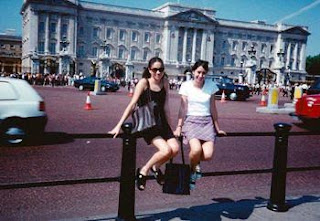
Meghan, aged 15, outside Buckingham Palace
It is possible, however, that Meghan had no idea how the monarchy worked. She may have thought she would be allowed to air her views and quickly discovered, or was told, that she could not. Perhaps she felt disappointed, frustrated and stultified.

The royals and their courtiers seem to have tried their best to help with her transition, including allowing the couple to have a six-week holiday break in the same year she’d taken maternity leave. But she expressed her unhappiness – as did Harry. After their holiday, the couple returned home without their baby. That seems unusual to me. If she intended to go straight back, why was the trip described as a holiday? 

So is it possible that nothing was ever going to be enough for Meghan?  

Here's a thought. As a counsellor, what would I say to a client with traumatic loss in his background who tells me he’s met someone with whom they want to spend the rest of their life. This person understands them completely, truly feels their pain and they, too, suffered trauma in their early life. My client feels whole with this person and my client has found the role he was searching for: a white knight and protector to his new love. I can see his self-esteem has soared. 

Over time, I hear about a few problems. His beloved started off being very charming with his family and very keen to be part of it. Now she doesn’t like the family and doesn’t attend family functions. The prospective partner no longer likes the job my client does, particularly as it involves other family members. The partner is obsessively secretive about certain aspects of her  – and my client’s – life and insists my client is “on-side” with that, even though part of the deal and financial perks of being a family member is that there is some public desire to know about my client’s immediate family life, including any children. He has done all he can to please her but now his beloved is talking about moving back to her country of origin and wants him to go with her, lock stock and barrel, while insisting that my client negotiates to retain major perks from his former work and family life. 

My client is too loved up to recognise the signs. I do and I worry.

By Lulu Sinclair


Top pic by Mark Jones - https://www.flickr.com

Saturday, 4 January 2020

Resolving The Resolutions

New year. New hopes. New resolutions.

Most of us make them, even if we don’t declare them out loud. There’s something about a new collective start that brings this inner determination to do something afresh.

I read the following in a newsletter from London-based Lidgates, organic butcher to the discerning.

“Babylonians made promises to their gods at the start of each year that they would return borrowed objects and pay their debts.

“The Romans began each year by making promises to the god Janus, for whom the month of January is named.
“In the Medieval era, the knights took the "Peacock Vow" at the end of the Christmas season each year to re-affirm their commitment to chivalry.

“This tradition has many other religious parallels. During Judaism's New Year, Rosh Hashanah, through the High Holidays and culminating in Yom Kippur (the Day of Atonement), one is to reflect upon one's wrongdoings over the year and both seek and offer forgiveness.” 

So there we have it, religious or otherwise, this is the time of year when we feel a deep inclination to do better.

I want to give a slight word of warning here. If you’re going to make one or two, keep them achievable. 
“I’m going to go to the gym; I’m going to lose two stone; I’m going to stop drinking.” 

These ideas sound fine when you’re full, fatigued, over-partied and bloated and completely dehydrated through drink. 

They may seem less appealing one week later when you’ve got post-Christmas blues and it’s dark, dreary and cold outside. The urge to reach out and eat, drink and – dare I say it? –  even smoke, may become irresistible.

And then, instead of feeling that sense of pleasure in yourself that you’ve taken charge of whatever it was you felt needed a bit more help, you’re left (if you’re as hard on yourself as I can be) feeling a failure, and all within a week of the new year. 

If that’s the case, what hope is there for the next 51 weeks?

May I make a suggestion? Avoid the absolute. 

I’ll use those three examples above but it’s applicable to any situation. Instead of: “I’m going to …” how about “I’m going to try to/I’m going to work towards …?” 

That leaves you room for manoeuvre. If you slip up, you don’t have to turn on yourself in fury or disappointment and then attack what it was you were giving up with renewed vigour. 

The “trying to” approach is kinder and less punishing internally which means you’re more likely to get where you’re planning to go. 

Otherwise, you’re in danger instead of meeting that immediate and devilish resistance that suddenly appears to be determined to put you off your stride. For example: “I’m not going to eat that biscuit” turns into an internal dialogue with a voice that says: “Oh yes you are, why shouldn’t you? And why would you want to stop at just the one?”

This idea of course isn't just about what a person takes in from outside. It can be applied to behaviour too. Less of the setting yourself up to fail with the determined “I will” and more of the understanding “I’ll try”. 

It’s about not just being kinder to others, but kinder within yourself too. You might find it quite effective.

Happy new year!


By: Lulu Sinclair


Photo 1 by Ayo Ogunseinde on Unsplash
Photo 2 by Zera Li on Unsplash


Sunday, 15 December 2019

Time To Travel Hopefully

So that’s it. It’s over. A general election – effectively a second referendum without actually naming the “R” word – and Brexit, whether we like it or not.

I’m not going to talk about that last part; opinion is probably still sharply divided. What I am going to say is I’m glad a democratic decision has at last been made. 

My relief is based on mental health grounds alone. The UK has had more than three years of anxiety around the subject and wondering what happens next and it’s not been good for most of us.

A study published in the BMJ of US trainee doctors has found they are not only stressed out by their training but also by what’s going on politically. As the shenanigans of their political masters are aired more publicly than they used to be, the fallout spreads further, across and down. 

I’m relieved a long-term study has found this because it’s always good to have evidential backup to what starts off as a gut feeling.

Here in the UK, until the recent past, we were used to grumbling politely about whatever was bothering us but for a short time and within a very confined space. We weren’t constant protesters – remember the march against the war in Iraq and how astonished everyone was that up to a million people had taken to the streets to express their views – and, mostly, we got on with our lives. That, I would suggest, is “normal” behaviour which allows us to live a reasonably healthy life.

How different we are now! Politically engaged, ranting on Twitter, not speaking to friends and families who disagree with us and generally behaving in a very un-British way. We surprised everyone – even our European friends and neighbours who thought we were stiff upper-lipped, pragmatic and not inclined to public argument. How we shocked them and how, probably, we shocked ourselves!

I don’t think it was the decision that caused the problem, it was what happened afterwards and that is what we have been left with for more than three years. 

And that is what changed on Thursday.

Again, this is not a personal political view. It is my professional observation on what happened.

Those who had changed their voting habits to enable such a huge change in the voting demographics were interviewed after they voted. They explained why they had done.

They sounded thoughtful, considerate and concerned. Some sounded pained and hurt, acknowledging that their own family values were being questioned at a fundamental level. I heard men and women saying how their father and/or grandfather “would be turning in their grave at what I’ve done”. None took his or her decision lightly.

The victor, PM Boris Johnson, acknowledged that when he spoke of voters “lending” him their votes. He knows he has to persuade them they did the right thing; otherwise, they’ll take their votes back again. 

So I suggest now is the time to celebrate the end of indecision. I remember being given advice by a doctor when I had no idea what to do with a particularly important decision I needed to consider in my personal life. “Do nothing,” he said. “And something will happen to make up your mind.”

When I wailed that I didn’t like uncertainly, he was kindly amused. “Nobody does. That’s the problem with humans. And that’s why we so often make an impetuous decision that is not right for us in the long term. We can’t bear to live with uncertainty.”

My uncertainty caused me enough grief. But it was my own problem. These past three years of uncertainty over our future as UK citizens have, however, been an enormous collective strain. The stress, seeming to stretch never endingly in front of us, became unbearable. 

We look to leaders to bear our anxiety for us, feeling we have chosen the right people to make the right choices for us as a collective group. Leaders are chosen to bear our burden and, for right or wrong reasons, they haven’t been in a position to do so. And it’s caused nationwide stress, discontent and unhappiness for much of the population.

And now it’s over. Now perhaps we can get back to enjoying the dullness of a mundane life. 

That’s what I’m looking for at any rate. I have no idea how it’s going to pan out but I’m hoping there’ll be someone out there among our political leaders with enough intelligence and skill to get us out of this mess. I’m an optimist and still believe politicians of all persuasions are trying their best on our behalf, even if we sometimes consider they are failing, or their views don’t fit with ours. 

I’m making my own decision. I’m going to free my mind from its post-2016 angst and hand back the reins of national decision-making to the newly elected politicians. Let’s hope they take care of me.


Photo by Shane Rounce on Unsplash